Lente Passioni
Pauline Curnier Jardin
À quandu ardente è barocca, à quandu kitsch è sensuale, o erotica è sanguinosa, l’opara di Pauline Curnier Jardin face un’analisi urdinata « in atti » di e strutture sucetale specifiche di e cumunità di l’Auropa suttana.
By turns fiery and baroque, kitsch and sensual, erotic and bloody, the work of Pauline Curnier Jardin provides an analysis in action of the societal structures specific to the communities of southern Europe.
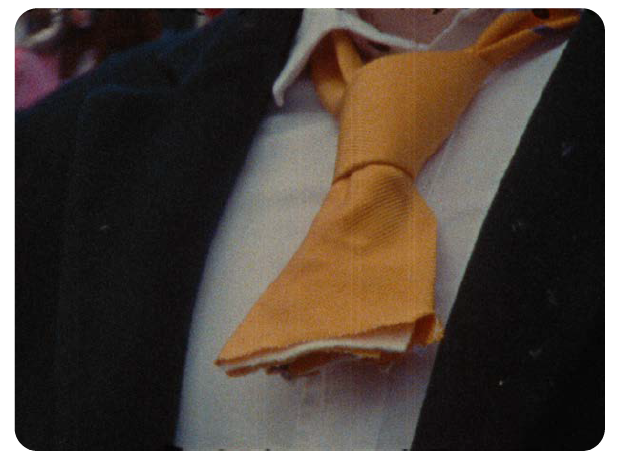
A teaser for an upcoming or fantasized film, Sebastiano Blu revisits the figure of Saint Sebastian to explore his queer dimension, the very one exposed by Japanese writer Yukio Mishima in Confession of a Mask in 1949. Pauline Curnier Jardin follows Giorgetto, an Italian religious singer and DJ, whose childhood memories date back to his presentation to the Saint, to guarantee his fertility, under the eyes of his mother and aunt. The artist then broadens the focus to all the women in the village "who can be frightening" and offers a true ode to matriarchy in a form flirting with the dreamlike. The subtitles, which accompany the images, in fact explore Giorgietto's ambivalent relationship with female figures who are both attractive and terrifying. They hint at his desire for a metamorphosis that could be resolved in his incarnation of the Saint, the object of the crowd's exclusive attention. The Super 8 images display the same vibrant character as in Explosion Ma Baby, playing with cuts and jolts, clashes and accelerations. They present a series of characters in reserve, fleeting protagonists of a scenario in the making, which mixes material and spiritual lives. The music takes on the trappings of a ritual chant to the point of distortion in order to open up to a sort of captivating trance. Thus, in this ceremony celebrating masculinity, Pauline Curnier Jardin manages to reinvest the figure of the witch to infiltrate everyday life and reverse this exacerbated virility, visible in the cult devoted to Saint Sebastian.


During the first lockdown due to the Covid-19 epidemic, Pauline Curnier Jardin edited a series of sequences collected online by a group of ethnomusicologists, both professional and amateur, gathered in a Facebook group. These scenes depict various Easter masses and processions in Catholic Europe, most often in Italy. The artist abandons the frenetic pace of these previous works to present polyphonic chants and rituals as a compilation of raw documents, recorded both on cell phones and video cameras. Music punctuates the many processions that accompany this week and gives a voice to the suffering. As an ethnologist artist, Pauline Curnier Jardin demonstrates the use of moving images in these collective gatherings as archives and holds up a mirror to her own practice. Far from detaching herself from these rituals, she shows that she has retained the critique of ethnocentrism specific to the historian of religions Ernesto de Martino who explained in The Magical World (1948): "Whether we reduce magical powers to empty beliefs or bring them back to psychic phenomena, we do nothing other than make them fit into a positive framework in defiance of what they represent within the cultures that experience them. It is therefore important to note that using parapsychology on magical powers also marks an attempt at rationalist understanding (which reveals its limits of phenomena that move on another historical plane), hence the need to pursue the analysis further by showing the organic insertion of magical powers into the cultural world that corresponds to them." Far from any positivism, Pauline Curnier Jardin develops a powerful empathy for believers that can be observed in the way her films reestablish a carnal presence in the world. A way of emphasizing that all existence is the translation of conditioning, that is, of a labile code that can be twisted and transformed, if one cannot completely get rid of it. This is the sign of powerful inventiveness.


His series of films on religious ceremonies places the symbolism of Christian rituals, and other pagan processions or carnivals, at the center of his vibrant observation, to better examine them physically. Thus, his ethnographic approach takes place as close as possible to the bodies and passions, the field study here requiring one to be affected by his subject. The joy, the songs, the trance, the cries, the jubilation, the fireworks, the colors, affirm an immersive dimension where contagion and fever are the expression of a powerful lyricism. The celebrations are therefore not just the small theater of a collective hysteria that the world of faith would generate, nor the simple survival of a devitalized folklore. On the contrary, they are the embodied signs of social practices whose codification subsists fully in a kaleidoscope of sensations and gestures. Pauline Curnier Jardin's visceral perspective then pushes us to understand that the subjective point of view is a way of challenging scientific impartiality, and thus a form of patriarchal authority, without departing from a meticulous critical investigation. The precise examination thus meets the grotesque in a poetics of the great divide that is definitively political.
Far from any objectification, Pauline Curnier Jardin's camera examines behaviors and beliefs in a way that favors action over concept, lived experience over bookish knowledge.
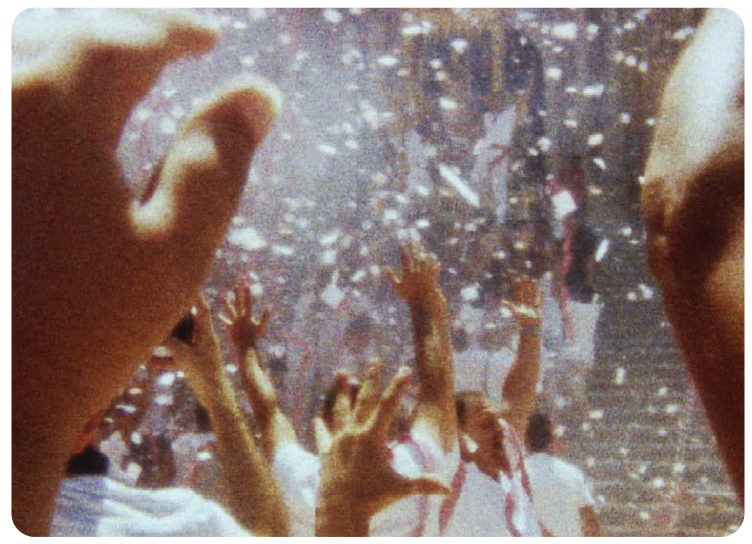
The image crackles under the effect of an explosion of party favors filmed with a Super 8 camera… In a frenetic mode that translates the excitement of being present at the heart of this summer event, Pauline Curnier Jardin transcribes the festive agitation in honor of Saint Sebastian in a Catholic city in the Eastern Mediterranean. Toddlers are held at arm's length towards the sculpture carried by a group of men, while money passes from hand to hand to be hung in the wind, under the whistles and other crackles of fireworks. The artist strings together fetishistic details, speeding up or slowing down the image, in order to create a deluge of sensations that the percussions accentuate. This exuberance of fanfare, which accompanies the offerings, translates the perseverance of a popular world of spending, of a necessary staging of excess, where the homo eroticism of the Saint comes to obliterate the figure of motherhood. And when the film resolves into a moment of suspension, which follows the climax, we understand that all these material signs participate in the regulation of a community of men, in search of a form of exaltation, which is ready for all the disguises of the truth to reach grace.
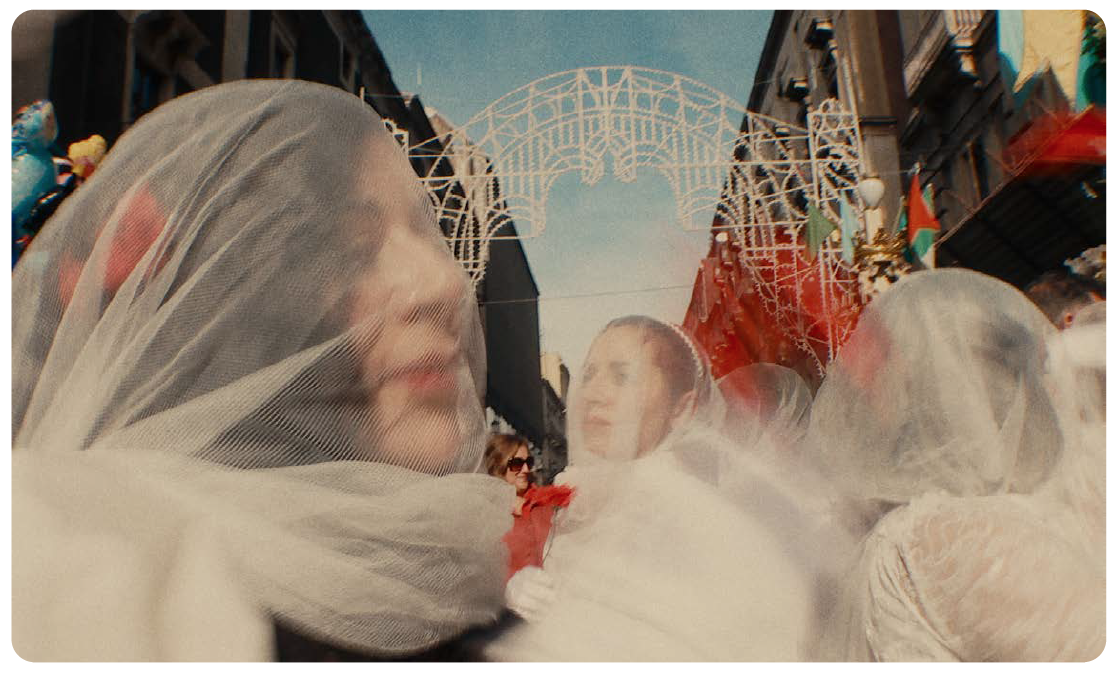
This work follows the procession of Saint Agatha in the city of Catania in Sicily, of which she is the patron saint. Known for a 5th-century passion, her life of martyrdom is also recounted in The Golden Legend (1261-1266) by Jacques de Voragine, who recounts that the young Virgin had devoted herself to God when she met the proconsul of Sicily, Quintianus, whom she refused. He had her imprisoned and had her breasts torn off with pliers.
While the Apostle Peter healed her wounds, she died from further abuse on the day of a terrible earthquake. A year later, Mount Etna poured torrents of lava toward the city, which the inhabitants managed to stop by using the Saint's veil that covered her tomb. Since then, Saint Agatha has been the patron saint of rape victims, women with breast cancer, and fire victims. At eye level, Pauline Curnier Jardin films the procession of February 5th where the faithful follow the Saint's float before taking us to the Cologne Carnival which takes place from Shrove Tuesday to Ash Wednesday, marking the beginning of Lent in the Christian tradition. These two festive events are shown alternately with the killing and butchering of a pig, as is customary in European villages, between December 26th and January 15th. The religious festival then takes on the appearance of a pagan fair with balloons floating in the air which create a kind of animist atmosphere and express the childlike wonder that the camera assumes. We eat, dance, dress up, put on makeup, laugh, in a warm atmosphere where the energy of the bodies is the indication that life is above all a matter of entropy. Blood, fat, sugar, and wax also reflect the processes of material transformation at work, in the same way that montage creates points of passage from one ritual to another. Tied and cut up, the pig suffers the same fate as Saint Agatha, in a sort of perpetual reenactment of her fate. And as Georges Bataille writes in La Part Maudite (1949) about the conjuring of death: "we lie to ourselves, dreaming of escaping the movement of luxurious exuberance of which we are only the acute form."